
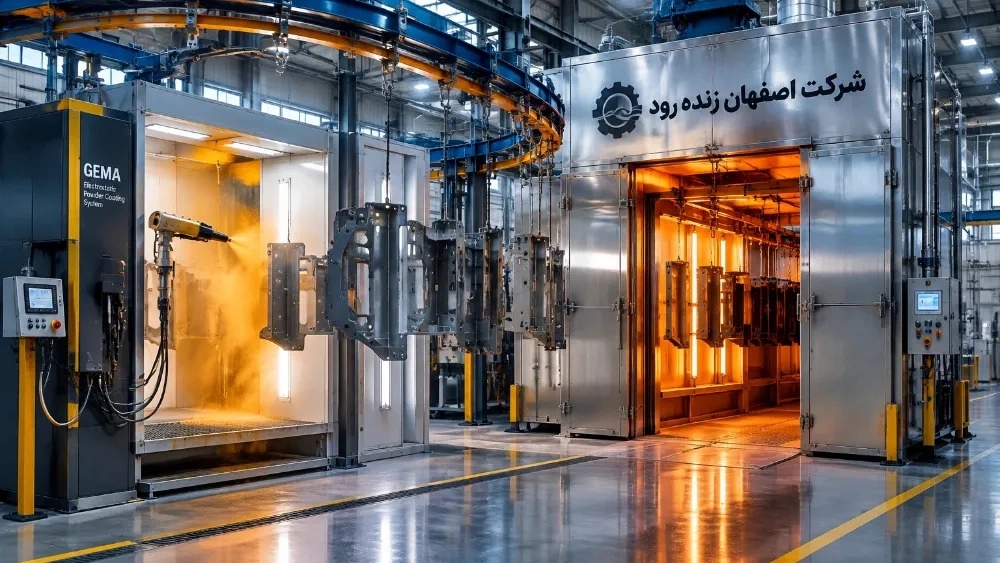
Electrostatic paint oven construction plan is one of the most important steps before designing and producing powder paint baking ovens. A standard oven should be able to create the temperature required for curing the paint with the least fluctuation in all parts of the enclosure, while taking into account energy consumption, safety, heating speed and the final quality of the coating. For this reason, the design of the electrostatic paint oven is not limited to the construction of a metal housing equipped with a burner or element.
In the powder painting process, the piece enters the oven after surface preparation and paint spraying. At this stage, the paint particles are melted and baked under the influence of heat and create a unified and resistant layer on the surface. Specialized sources mention different intervals for baking powder colors; For example, some systems suggest a temperature of about 180-220 degrees Celsius and a time of about 10-20 minutes as a common range, but the exact value should be determined according to the manufacturer's color specification and curing curve.
What is an electrostatic paint oven?
Electrostatic paint oven or powder paint baking oven is an industrial chamber for creating suitable thermal conditions for baking and stabilizing powder paint on parts. The powder paint is placed on the surface in the form of fine particles before the part enters the furnace, and it does not have the final strength yet. Entering the piece into the oven causes the powder to melt, flow and then bake due to the increase in temperature.
In an electrostatic powder coating line, the oven is only one of the process components, and parts such as washing and surface preparation, dryer, spray booth, sprayer, recycling system, baking oven and conveying system can also exist in the line.
Therefore, Electrostatic Paint Furnace Construction Plan should be designed according to other parts of the paint line. The dimensions of the part, the production capacity, the method of transferring the parts and the type of paint used, all have an effect on the characteristics of the furnace.
Why is the construction plan of the electrostatic paint furnace important?
Preliminary design and preparation of a detailed plan are very important before the construction of the furnace. If the dimensions, air circulation path, heating system or insulation are chosen without calculation, the furnace may have sufficient temperature in some places and excessive temperature in other places.
A suitable electrostatic paint oven construction plan should specify at least the following:
- Internal and external dimensions of the oven
- Length, width and height of the chamber
- Type and thickness of thermal insulation
- Type of heating system
- Installation location of burner or element
- Hot air entry and circulation path
- Circulation fan location
- Air return path
- Location of sensors and temperature control equipment
- Doors and opening and closing location They are
- required evacuation or ventilation system
- safety equipment
- electrical and control system
- how to transfer parts into the furnace
These details make the manufacturing process more accurate and increase the possibility of quality control and future repairs.
The main components of the electrostatic paint oven
Furnace body
The body is one of the main parts in the construction plan of the electrostatic paint furnace. The structure of the body should be such that it can withstand heat, continuous operation, and the conditions of the industrial environment.
In the design of the body, an internal space is usually considered for placing the part and a multilayer structure to reduce heat transfer to the environment. The quality of making connections and sealing is also very important; Because heat leakage will increase energy consumption and reduce furnace efficiency.
Thermal insulation
Correct insulation is one of the most important parts of furnace design. The task of insulation is to reduce heat transfer from the hot space inside the furnace to the outside environment.
Choosing the type and thickness of the insulation should be done according to the working temperature, dimensions of the furnace, the structure of the walls and the conditions of use. Poor insulation or its improper installation can cause an increase in fuel or electricity consumption, overheating of the external body and loss of efficiency.
Heating system
The heating system can be different according to the capacity, dimensions and type of use of the furnace. In industrial design, the selection of the heating system should be based on the required thermal power, the speed of reaching the working temperature, the method of heat transfer and the operating cost.
In some furnaces, systems based on burners and heat exchangers are used, and in some applications, electrical systems are used. The choice between these methods should be made by the designer based on the actual conditions of the project.
Hot air circulation fan
Simply generating heat is not enough to build an electrostatic paint oven. Hot air must circulate in a controlled manner in the chamber so that the temperature of different points is as uniform as possible.
Circulation fan and internal ducting routes must be specified in the furnace construction plan. Improper design of the air flow can cause cold or hot spots and as a result of uneven baking of paint.
The uniformity of temperature is very important; Because baking more or less than the required amount can affect the appearance and performance of the coating.
How are the dimensions of the electrostatic paint oven determined?
One of the common mistakes is to choose the dimensions of the furnace only based on the dimensions of the part itself. In the professional design, the necessary space for the entry of the part, air circulation, safe distance from the walls, transmission system and maintenance conditions should also be considered.
For example, if the parts are going to pass through the furnace by a conveyor, the speed of the conveyor and the time required for baking will affect the length of the furnace.
In box furnaces, the dimensions of the chamber mostly depend on the largest part and the capacity of each cycle. In tunnel furnaces, in addition to the dimensions of the piece, line capacity and transfer speed also play an important role.
For this reason, the electrostatic paint furnace construction plan should be prepared after specifying information such as the following:
- Maximum dimensions of parts
- Weight of parts
- Number of parts per cycle
- Production capacity
- Method of transferring parts
- Type of powder paint
- Temperature required for firing
- Time required for firing
- Available energy source
- Installation space conditions
Box or tunnel electrostatic paint oven?
Powder paint baking ovens can be produced in different ways based on the type of use and line design. Two common examples are box furnace and tunnel furnace. Specialized sources have also introduced these two structures for powder paint lines.
box furnace
The box furnace is very useful for workshops where parts of specific dimensions and numbers enter the furnace. The parts are placed inside the chamber, the door is closed and the heating and cooking cycle is done.
One of the advantages of this structure is greater flexibility for various parts and the possibility of designing in different dimensions.
tunnel furnace
Tunnel furnace is mostly used for continuous production lines and higher capacities. The parts pass through the furnace with the help of the transmission system and the baking process is done along the way.
In this case, the speed of the conveyor, the useful length of the oven and the time the piece stays in the appropriate temperature range are directly related to the capacity of the line.
Important calculations in the construction plan of the electrostatic paint furnace
Also, the power of the heating system should be checked for different conditions such as initial start-up and stable operation.
In an engineering design, the following are considered:
Thermal load of the parts: the energy required to bring the parts from the ambient temperature to the process temperature.
Thermal load of the chamber: the energy required to heat the internal components of the oven.
Heat loss: Heat that leaves the system through walls, doors, seams, and entry and exit paths.
Circulating air: The amount and speed of air circulation should be in harmony with the capacity of the fan and the design of the channels.
These calculations make the heating system to be chosen neither too big nor to have enough power during work.
The importance of temperature control in the powder paint oven
Temperature control is one of the most important parts of the electrostatic paint furnace construction plan. Installation of suitable sensor, temperature controller and safety equipment should be specified in the design phase.
The temperature displayed on the controller does not necessarily mean that all points of the part have reached the same temperature. In sensitive applications, examining the part temperature curve and baking test can provide more detailed information about the actual process conditions.
For this reason, the choice of baking temperature should not be based solely on a fixed number. The technical specifications of the powder producer, the material and thickness of the piece and the condition of the line should be considered.
Some sources for powder paints mention ranges such as 180 to 220 degrees Celsius, but the exact curing time and temperature should be determined from the specifications of the paint used.
Hot air circulation system in the furnace
One of the most important parts of the design is the hot air path. If the air collects in only one part, it is possible to create a temperature difference in different places.
The fan should be selected and installed in such a way that proper air circulation is created in the entire enclosure. The design of channels, valves and the return path should also be included in the map.
The goal is that the piece is thermally placed in a condition where the baking process is done uniformly. This has a direct effect on the appearance quality, adhesion and final properties of the coating.
Design and construction stages of electrostatic paint furnace
the first stage; Checking the need of the project
At first, the type of parts, production capacity, dimensions of parts, weight, transfer method and type of color should be specified.
the second stage; Determination of dimensions
After receiving the project information, the internal useful dimensions of the furnace and the space required for the equipment are determined.
the third stage; Choosing a heating system
At this stage, based on the capacity and conditions of the installation site, the appropriate heating system is selected.
the fourth stage; Insulation and body design
The structure of the walls, thermal insulation, internal and external coating and assembly method are determined.
the fifth stage; Air circulation design
Fan, air circulation paths and heat flow entry and return are designed.
The sixth stage; Electrical design and control
Electrical panel, temperature control, sensors, protective equipment and control systems are specified.
the seventh stage; Construction and assembly
After approval of the plan, parts are made, body assembly, insulation installation, heating system and control equipment are done.
the eighth stage; Testing and commissioning
After construction, furnace performance should be checked in terms of temperature rise, heat uniformity, fan performance, controllers and safety equipment.
Safety in design of electrostatic paint oven
Powder paint oven is an industrial thermal equipment and safety should be considered from the design stage. Protection against excessive temperature increase, emergency shutdown, burner or heating system control, proper insulation and proper ventilation are among the things that should be checked by the expert designer.
Also, the electrical system and control panel should be selected according to the working conditions of the equipment. The implementation of thermal and electrical facilities must be done by qualified people and in accordance with the safety requirements of the place.
The role of Isfahan Zindaroud company in the design and construction of paint furnaces
Choosing the right manufacturer to implement the project is as important as preparing the electrostatic paint furnace construction plan. Isfahan Zinda Roud Company can be considered as an active group in the field of industrial equipment and solutions, for designing and implementing paint furnaces according to the needs of the project.
In a basic project, first the production needs are checked and then furnace dimensions, thermal capacity, air circulation system, insulation, temperature control and how to transfer the parts are determined.
The advantage of working with a specialized group is that the furnace is not made simply as a warm enclosure; Rather, its specifications will be coordinated with the actual conditions of the coloring process.
If your goal is to build a furnace for a small workshop, production line of metal parts, profiles, industrial equipment or mass production, the technical specifications of the project should be checked before construction. Isfahan Zinda Roud Company can be used in examining the need, designing the structure and implementing the appropriate solution for industrial projects.
The price of making an electrostatic paint oven depends on what factors?
The price of a furnace cannot be determined only based on its appearance. Various factors affect the final cost:
- Furnace dimensions
- Box or tunnel furnace type
- Heating system type
- Insulation level
- Body type
- Production capacity
- Number of fans
- Control system
- Safety equipment
- Conveyor type
- Automation level
- Installation conditions and Launch
Therefore, instead of looking for a fixed price, it is better to provide the project specifications to the manufacturer so that design and cost estimation can be done based on real needs.
Why is custom furnace design important?
Each production line has its own conditions. Two sets may be similar in terms of the name "Electrostatic Paint Furnace", but they are completely different in terms of part dimensions, production capacity, baking time, color type, transfer method and heating system.
For this reason, using a general design without checking the project conditions is not always the best solution. Custom design can make the furnace better coordinate with the production process and use the factory space more effectively.
summary; Choosing the right plan for making an electrostatic paint oven
Electrostatic Paint Furnace Construction Plan is the main basis for implementing a standard industrial furnace. In this plan, the dimensions, body, insulation, heating system, fan, air circulation path, temperature control, electricity, safety equipment and the method of transferring parts should be designed in harmony.
A suitable oven should be able to create the required thermal conditions of the paint in a uniform and controllable way. The temperature and curing time should also be determined according to the type of powder and specifications announced by the paint manufacturer; Because improper cooking can reduce the quality of the coating.
To implement a successful industrial project, it is better to check the complete information of parts, production capacity and painting process before construction. Isfahan Zinda Roud Company can be an option to review and implement projects related to furnaces and industrial equipment.
If you are looking to design and build an electrostatic paint oven, prepare a plan for a powder paint oven and implement a system that fits your production capacity, getting expert advice before construction can prevent the costs of modification and subsequent changes.